The Gearbox Running Backwards: How a Luxury Watch Movement Borrows From Industrial Engineering

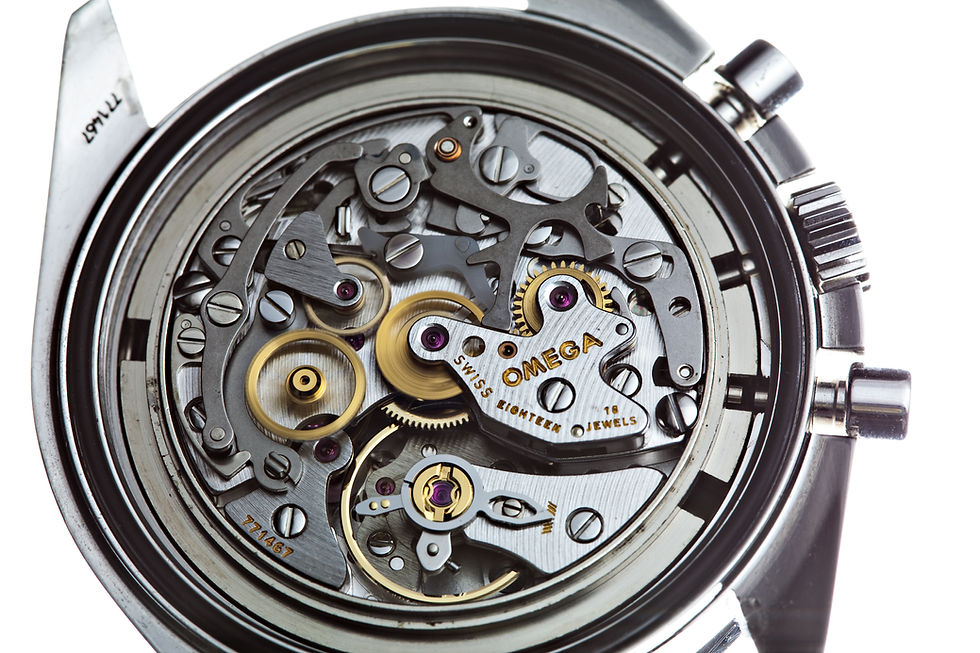
Turn a luxury watch over and you're looking at a gearbox that runs backwards. A car's transmission mostly trades engine speed for torque at the wheels. A watch's gear train does the reverse. It takes the slow, heavy pull of a coiled mainspring and steps it up, stage by stage, until the escapement can meter it out in tiny pulses. In Rolex's calibre 3255, the oscillator at the end of that chain beats eight times per second, more than 250 million times a year.
Same physics, opposite brief. That's why the watch is worth a fashion reader's attention: Switzerland alone exported 14.6 million watches worth 24.4 billion francs in 2025, and every mechanical one among them is a working gear train you wear on your wrist.
What's actually inside
Start with the gear train. As Revolution explains, the train converts the barrel's slow rotation into the speed the escapement needs; the fourth wheel turns 60 times for every turn of the centre wheel. That 60:1 step is the gearbox ratio of timekeeping.

The tooth shape is where horology and industry really meet. Industrial gearing runs on the involute profile, and the standard metric rack uses a 20° pressure angle, which has worldwide acceptance. But the same reference shows the catch: at 20°, a gear needs about 18 teeth to avoid undercutting. Pinions in watch movements often have just six to ten leaves. An undercut involute pinion that small would be fragile and hard to make, which is why watchmakers long preferred cycloidal teeth: fewer points of contact, flat pinion flanks that polish easily, and teeth that can run without oil.
Then industry won anyway, on tolerances. Revolution traces the shift to involute watch gears back to Heinrich Stamm in the 1940s, whose work became the ETA standards of the 1970s, and to Michel Belot, who used computer simulation to tune involute profiles for watch use. Gear specialist Jérémy Freléchox puts the reason plainly: "The size of watchmaking components induces geometric variations that are proportionately large in relation to their size." An involute tolerates small errors in centre distance; a cycloid doesn't. The Valjoux 7750 chronograph runs on involute gears, and the most common pressure angle in watchmaking today is the same 20° you'll find in industrial catalogues.
The escapement is where the energy goes to die, and where the engineering gets sharp. Rolex's own calibre 3255 documentation says the conventional Swiss lever escapement relays "barely more than a third of the energy it receives from the mainspring." Its Chronergy redesign used numerical modelling to reverse the length ratios between escape-wheel teeth and pallet stones, halved the pallet stones' thickness to 125 microns, offset the geometry to multiply the lever effect, and made the pallet fork and escape wheel in nickel-phosphorus by LIGA electroforming. Rolex claims a 15 per cent efficiency gain. Thinning the barrel walls by half added more than ten hours of power reserve.

Patek Philippe went further into factory territory. Its 2011 Advanced Research release describes silicon parts made by deep reactive ion etching, a process widely used for micromechanical parts, machined "to thousandths of a millimeter" and identical in shape and mass. Its Silinvar escape wheel of 2005 needs no lubrication.
The literal automotive borrowing exists too. TAG Heuer's Monaco V4, shown as a concept in 2004, used mechanical transmission belts and a linear winding system, with its four barrels mounted on ball bearings.
The TDW house view
Let's give the sceptics their due. Car-and-watch partnerships are often more marketing than engineering. Europa Star found the promotion almost entirely one-way: watch brands shout about their "car-inspired" editions, while the carmakers barely mention them. A rev-counter dial is not a transmission.
But the real crossover isn't styling. It's that horology took industry's standards and then argued with them. It adopted the 20° involute because tolerances demanded it, kept cycloidal teeth where low torque made friction the bigger enemy, and borrowed semiconductor etching to make parts no hand could. That's the lesson for the rest of you: borrow the standard, then tune it to your scale.
What this means for designers
If you design accessories, you're working at the scale where tolerances turn into feel. A clasp, a hinge or a buckle has the same problem as a pinion: errors that are tiny in absolute terms but huge relative to the part. Pick geometries that forgive, as the involute does.
If you design products or cars, look at how watchmakers verify. COSC tests movements over 15 days, in five positions and at three temperatures, to an average daily rate of −4 to +6 seconds, and every certified movement carries its own engraved number. Rolex says its tests on cased watches are twice as exacting. Imagine your product held to a published standard like that, one numbered unit at a time.
The long arc
Watchmaking spent centuries perfecting gears by hand, then quietly handed the drawing board to the same standards, simulators and etching tools that run modern industry. The craft didn't disappear. It moved into deciding which industrial rule to break, and where. That's the part of the watch worth wearing.


Comments